More than “talk to your data.”
We started in healthcare, integrating the systems no one else wanted to touch. Then we realized: the same infrastructure that makes integrations trustworthy makes AI trustworthy.
The Results
FlumePublished Research
Published benchmarks: Spider 2.0, ICLR 2025.
Research baseline: Sequeda, Allemang & Jacob, ACM SIGMOD 2024. Flume: internal evaluation, Q1 2026.
Why Enterprise AI Breaks
Four failure modes no model
can solve alone.
01

Context window overload
Stuff hundreds of tables into a prompt and the model loses what matters.
02
No memory between runs
Every session starts from zero. The model can’t learn which joins work or what broke last time.
03
Join hallucination
The model writes SQL that executes, returns plausible numbers, and is completely wrong.
04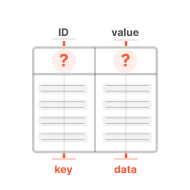
Schema ≠ meaning
Column names don’t explain business logic. Naming conventions can’t be inferred from metadata alone.
How It’s Built
Infrastructure that earns trust.
/∞
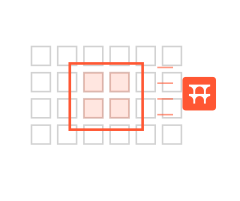
Subgraph resolution
Resolves only the relevant subgraph before generation.The prompt stays small and focused.
/∞
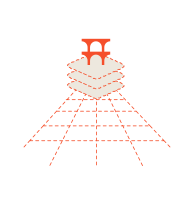
Persistent graph
Every validated join compounds over time.No cold starts.
/∞
Confidence-scored joins
Trusted join paths with confidence scores.The model reads validated relationships, not guesses.
/∞
Human artifact ingestion
Docs, tickets, and tribal context encoded alongside schema.Meaning, not just column names.